Recipes

  • Roast lamb Roman style

    Roast lamb Roman style

    This is a very, very tasty dish. The ingredients are simple enough but collectively they pull together to deliver a hearty, winter-themed flavour. It is based on a dish of baby lamb demonstrated by Melbourne chef Guy Grossi at one of his masterclasses.


    Having cooked it for friends or more than one occasion it remains a firm favourite for its easy one-pot method, delicious flavour and grand presentation at the table in the cooking vessel. In my case that’s a huge, heavy, cast iron fry-pan bought from a sporting/camping goods store. This fabulous receptacle just fits into my generously-sized Australian made oven filled with enough lamb and potatoes to feed eight people. If you have a prissy European oven or no single large baking dish, but still need to feed the multitudes, decamp it into two dishes. You’ll need more liquid than is stated for the one pot version.

    With no baby lamb available my butcher kindly jointed some lamb shoulder and neck meat into large serving chunks. We conspired to leave the bone in, in a departure from Grossi’s original, but it still worked a treat.

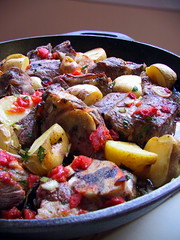
    Real baby lamb will cook in a little over an hour especially if it is boned. Standard lamb with the bone left in will take a couple of hours in a moderate to low oven. You can part cook the dish ahead up to the stage of sprinkling over the breadcrumbs and parmesan. Available light fading fast on an overcast afternoon, the photograph here was taken after barely an hour’s cooking with another half or so to go before the addition of the crumb topping but you’ll get the idea of how glorious the final presentation is topped with golden crumbs.
    The dish deserves a great wine – hard to go past Marchese Antinori Chianti Classico

    The Recipe

    Roast lamb Roman style (for eight)
    2.2kg lamb from shoulder and neck cut into about 20 serving sized chunks, bone in
    2 onions, chopped
    6 cloves garlic, cut into quarters
    8 rosemary springs
    8 sage leaves
    good handful of flat-leaf parsley, chopped
    1 large fresh red chilli, chopped
    salt and pepper
    6-8 medium sized waxy-fleshed potatoes, cut into large chunks
    400g tin Italian chopped tomatoes and their juice
    1 cup extra virgin oil
    half bottle dry white wine
    water
    100g grated Parmesan
    200g fresh breadcrumbs
    extra sprigs of rosemary
    Pre-heat the oven to 170C. Mix together the breadcrumbs and Parmesan.
    Drizzle a little of the oil over the base of a heavy, wide, baking dish. Place the lamb in the dish and scatter over the onion, garlic, sage, rosemary, parsley and chilli. Season generously with salt (more than you think) and black pepper and pour over half the remaining olive oil. Massage the lamb pieces with all the seasonings. Tuck the potatoes among the lamb pieces. Spoon over the tomatoes and juice. Pour over the white wine and then drizzle with the rest of the olive oil.
    Add enough water to come about half way up the lamb pieces. This will provide moisture during cooking and will allow for some delicious juices at the end of the cooking time. Cook for about an hour and a half, turning the lamb and potatoes around in the cooking juices from time to time.
    Sprinkle over the crumb mix. Place back in the oven for another hour or until the crust is golden and the lamb is cooked. Top up with water from time to time to keep the lamb moist and some serving juices in the pan. Tuck in a few fresh rosemary sprigs here and there just before serving.
    Serve in the cooking vessel with a green vegetable or salad on the side.
    Continue reading
  • Herb focaccia with prosciutto filling

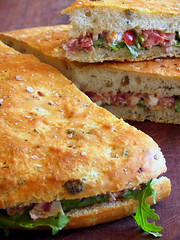
    Herb focaccia with prosciutto filling

    In Italy cafes everywhere are well stocked with any time snack treats. We don’t think of Italy as sandwich territory but they do it particularly well.

    Tramezzini are divine and with their trimmed off crusts and soft white bread they are refined enough for any high tea. They’re distinguished from their Anglo counterparts though by particularly piquant and savoury fillings. A little more rustic are the whole wheels of focaccia filled with moist and tasty bits and pieces. This may simply be slices of fresh mozzarella and prosciutto (that can be eaten hot or cold) or more elaborate mixtures such as the one below. All are delicious, as much because of the quality of the bread as the filling. In this respect proper Italian focaccia is an entirely different beast to the puffy, cakey and bland pretenders that we often see in our shops.

    You can make the focaccia in a mixer with the dough hook attached or in a food processor. A machine is desirable because the wet nature of dough makes it a bit awkward to knead entirely by hand. For most Italian breads it is better to err on the side of wetness when making the dough. I had one of those oops moments when preparing this focaccia dough after I added what I thought was just a little extra water. Given that the dough never quite left the sides of the bowl to form a nice ball I thought I’d gone too far. Wrong – it was the best focaccia I’ve yet made. If the dough does seem very sticky when you turn it onto the bench to give a turn or two by hand, sprinkle it with more flour and keep your hands well coated.

    Make sure to use strong bread flour when making any bread. It has more protein than standard flour. Developing the protein through kneading is what makes the dough elastic enough to rise. Generally I use Lowan’s Unbleached but the neighbourhood deli had a bag of special Italian bread flour and despite being initially sceptical it did make a beautiful focaccia. Lovely luncheon dish with a glass of Anselmi San Vincenzo Soave.

    The Recipe

    Herb focaccia with prosciutto and rocket filling
    For the focaccia:
    In a mixer bowl with the dough hook attached place 300g bread flour, 1 tbsp chopped rosemary leaves, 4 sage leaves torn into tiny pieces, 2 cloves garlic finely chopped, 1 tsp salt (generous), half teaspoon sugar and 1 tsp instant dried yeast. Blend together. With the machine running pour in 200ml medium hot water with a tablespoon olive oil. Knead the dough in the machine on medium speed for four minutes. Turn onto a well floured surface and knead for a minute or until smooth. Place in a warm, oiled bowl, cover with plastic wrap and tea towel and stand over hot water (or in a warm place) until double in size – 1-2 hours. Knock down, knead lightly again and then press out into a large round about 1.5cm thick. Dimple the surface well with your fingers and leave to rise again – 30-45 minutes. Meanwhile heat the oven to 220C. When the dough is ready gently smear generously with olive oil and sprinkle with salt flakes. Bake for 10 minutes then turn down heat to 180C to bake for a further 10-15 minutes. Cool on a rack.
    For the filling:
    Chop 15 slices prosciutto. Chop 2 large ripe tomatoes or 6 cherry tomatoes into small pieces. Rinse a tablespoon of salted capers and dry before chopping finely. Chop the white and yolk of a hard-boiled egg. Mix together the prosciutto, tomato, capers and egg with half a cup Bests (blue lid) mayonnaise.
    To assemble:
    Cut the cooled focaccia in half horizontally. Spread the bottom very lightly with a smear of mayonnaise. Layer generously with baby rocket leaves. Spread the prosciutto filling over this. Place the top on and press down gently. Cut the focaccia carefully with a bread knife into 8-10 wedges.

    Continue reading
  • Blinis with ocean trout

    Blinis with ocean trout

    This is a spoil everyone, luxury indulgence treat. Blini are small, savoury pancakes of Russian origin, reminiscent of the humble pikelet but made instead with a rich yeast batter.


    Traditionally the batter is made from a mix of unbleached bread flour and buckwheat flour. For some reason the first recipe I tried featured rye flour instead and that is what I’ve always used with great success. In some versions the yeasty batter is further lightened with whipped egg whites just before cooking but ever being happy with the original I’ve not seen the need to add complications to what is a really easy, no-fail recipe. That’s its great strength; the batter is very forgiving as are the pancakes once they have been cooked.
    This recipe will make about 50 blini, something that will take about half an hour with two fry pans on the go. But if you wanted to whip up a few today and then some more tomorrow the batter will sit happily in the fridge overnight. Next day you may notice that the blini batter has lost a bubble or two but it soon perks up once it hits the hot pan. If you want to cook them all in one batch the day before a big event simply pop them in single layers on a large tray, baking paper between the layers, and wrap well in cling film.
    The next day they’ll just need a refresh in a low oven for five minutes and a short cool before proceeding with the topping. They are indeed best if served very slightly warm with the cold horseradish cream and salmon a nice contrast. Blinis are excellent with sparkling wine or Champagne, try Lake Barrington Alexandra

    The Recipe

    Blini with smoked ocean trout, horseradish cream and salmon roe
    600ml milk
    half tsp sugar
    1 tsp salt
    50g butter
    half cup crème fraiche (or sour cream)
    2 large eggs
    2 and a half cups unbleached flour
    three-quarters cup rye flour
    1 tsp instant dried yeast (Fermipan or equivalent)

    Scald the milk and add salt, butter, sugar and sour cream. Cool and beat in the eggs. Place the flours and yeast in a large mixing bowl. Pour in the milk and egg mixture and mix well with a wooden spoon or hand whisk until smooth. Add a little more milk if batter is too stiff. It should be of a dolloping consistency but not too runny. Let rise for an hour or two in a warm place, until bubbles form. Scoop out dessertspoonfuls and cook like pikelets over moderate heat in a butter-greased non-stick pan, turning once when bubbles appear on the surface. Cool on a cake rack.

    To serve:
    200ml King Island creme fraiche or rich sour cream
    3 tsp prepared horseradish (available in jars)
    good pinch sugar and salt
    squeeze of lemon or lime
    slices of smoked ocean trout or salmon
    salmon roe (optional)
    chives, cut into short lengths
    Whip the creme fraiche and the horseradish together with the sugar, salt and lemon until quite stiff. Refrigerate or use immediately. Spread freely over two-thirds of the blini. Place a drape of salmon on top then garnish with a dollop of salmon roe and/or lengths of chive.

    Continue reading
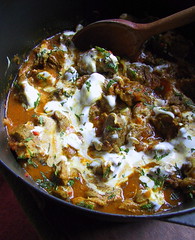
  • Lamb curry with yoghurt & tomatoes

    Lamb Curry with yoghurt & tomatoes

    ‘What do you fancy?’ Such is my query of friends and others that I encounter during the days immediately preceding the deadline for my weekly food column.

    Curry got the most mentions and I’m happy about that, because it was just what I fancied. And lamb was the object of desire. Now, many people cop out when stewing lamb and go for the leg. I know why. It’s because leg meat is always available. Not true of the best cut for a lamb stew – the shoulder or the neck.

    For these now ‘old-fashioned’ cuts you need to find a butcher who actually has bits to butcher, not just pre packs of already trimmed up muscles. That way when you ask for a boned out shoulder your butcher will look surprised and pleased because he has the very thing out back and not surprised (because no one has asked for shoulder meat since our grandmothers were at the stoves), and down in the mouth because he has nothing to sell you. Where do all the good lamb stewing cuts go now we’re so fixated on the glamour parts?

    This is a basic lamb curry made easy with the use of a quality curry spice mix. Herbie’s Spices is the brand of choice and the curry mix with whole seeds and spices is my favourite. If you wanted to save more time, ask the butcher to trim up the shoulder and cut the meat into large cubes. It is however, very therapeutic doing this task yourself and you can remove as much fat as you like – much easier to slice off in big pieces than re trim already cubed meat.

    ‘A stew boiled is a stew spoiled’ is not just cooking cliché. Cook the curry over the lowest heat possible, with barely a bubble or two visible. For shoulder meat the cooking time may take from three to four hours. Just keep checking on that advancing state of melting tenderness.

    The Recipe

    Lamb curry with yoghurt & tomatoes
    1.5 kg lamb shoulder, trimmed and cut into large cubes
    2 onions, cut into half rings
    2 cloves garlic, chopped fine
    2cm piece ginger, peeled and chopped fine
    1 large red chilli, seeds removed and chopped fine
    2 tbsp ghee
    2 tbsp Herbies Curry Spice Mix
    2 large tomatoes, peeled and diced
    2 tsp salt
    1 tbsp mint leaves, chopped
    ½ tsp garam masala (a mix of sweet, fragrant spices)
    150g plain yoghurt
    1 tbsp mint leaves, chopped, extra
    Heat the ghee in a large pot. Saute the onion, garlic, ginger and chilli till soft and golden.
    Add the curry powder and sauté for a minute. Add the meat and mix very well. Saute for a minute or two. Add the tomatoes and mint, stir, cover and cook over very low heat for three hours or until the meat is tender. Five minutes before the end, stir in the garam masala, yoghurt and extra mint.

    Continue reading