Recipes

  • Blanquette of lamb

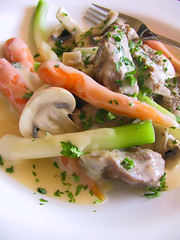
    Lamb blanquette

    Blanquette of lamb is a luxurious dish of succulent spring lamb served with baby vegetables in velvety textured sauce.

    The blanquette method (derived from the French word for white, ‘blanc’) is suitable for veal, young lamb or chicken.
    Talk to your butcher about sourcing the lamb. There are many farmers around the country who go to considerable effort to ensure the quality and consistency of their fresh product. Good butchers develop close relationships with these suppliers and promote the origin (or ‘brand’) of the product on their shelves as something consumers can trust.

    For a blanquette the meat is cooked in stock and the resultant sauce thickened with flour and butter The final step is to enrich it with egg yolks and cream. Mushrooms and little onions are traditional accompaniments. Even though it strays slightly from the white theme, veal stock is excellent as it gives great flavour to the final sauce. As for the accompaniments, mushrooms and their cooking liquor are essential but you could add any baby vegetables – carrots, leeks, pickling onions, turnips, snow peas… Match up with the divine silkiness of 2004 Bald Hills Pinot Noir from Central Otago.

    The recipe

    Blanquette of lamb (serves 6 or more)
    To cook the lamb:
    2kg milk fed spring lamb – boned breast, neck and shoulder cut into 5cm cubes
    veal stock to barely cover
    2 medium carrots, cut into quarters
    2 medium onions, peeled, halved and two halves stuck with a clove each
    bouquet garni – lengths of celery stick, spring of thyme and parsley stalks tied together
    Bring the lamb and veal stock to a gentle simmer in a large pan. Skim the surface of impurities. Add the vegetables, bouquet garni and salt if the stock is not salted. Simmer gently, lid on for an hour and twenty minutes or until the lamb is tender.
    Strain the stock from the lamb and reserve. Discard the vegetables from the lamb. Strain the stock through a sieve lined with muslin back over the lamb. Keep warm. Just before preparing the sauce, drain the stock from the lamb completely. Reserve the stock.

    Preparing the vegetables:
    250g tight white mushrooms, cut in halves or quarters if large
    knob butter
    100ml water
    1 tbsp lemon juice
    salt and white pepper
    In a medium saucepan simmer the mushrooms with the other ingredients for 2 minutes. Drain the cooking liquor and reserve.
    Simmer 12 spring onions, pickling onions (peeled) and/or leeks in water until tender. Drain and keep warm. Simmer 18 baby carrots and/or turnips in water until tender. Drain and keep warm.

    For the sauce:
    60g butter
    2 tbsp, rounded, plain flour
    lamb stock
    mushroom cooking liquor
    2 egg yolks
    2 tbsp cream
    chopped parsley
    Heat the butter in a large saucepan. When foaming add the flour, stir well and cook the roux for a minute. Whisking all the while add about 1 litre of warm lamb stock and all of the mushroom cooking liquor – this really gives the sauce something! Simmer gently for a minute or two. If the sauce is too thick, add some more stock. In a small bowl whisk the egg yolks and cream together. Add a spoonful of warm lamb stock and then whisk the egg liaison into the thickened sauce. Bring to just under a simmer. Taste and adjust seasoning.
    To serve: Add the mushrooms to the lamb. Pour the enriched sauce over. Portion the vegetables to individual plates. Add the lamb and mushrooms, napping the vegetables with some of the sauce. Sprinkle with parsley and serve. Rice is a traditional accompaniment.
    Continue reading
  • Scallops & prawns with asparagus

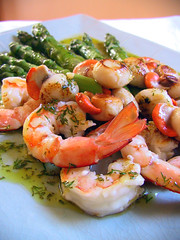
    Scallops & prawns with asparagus

    This simple celebration of spring is a versatile idea that can be readily adapted to suit available ingredients.

    Until he retired in 1996, famed Swiss Chef Fredy Girardet ran a Michelin 3 star restaurant in Crissier. His first book, Cuisine Spontanee was published in 1982. It is only in recent years that he’s released the second!

    Girardet is noted for his light but detailed touch. Some recipes have been described as “daunting in their detail” but even though the instructions are explicit and detailed, they leave little room for error. The recipes in Cuisine Spontanee are achievable and the results exceptional. Girardet’s original features grilled scallops, langoustines and asparagus. Sweet, new season’s scallops and asparagus are now in the shops but exotic crustaceans might be harder to find for those outside large centres. Frozen green King prawns are a more than fair substitute, but if you do have access to Moreton Bay bugs, baby marron or their kin do take advantage.

    Using this basic idea you could make a bountiful seafood and spring greens platter using a variety of bivalves and crustaceans accompanied by tender asparagus (white and green) and even snow peas. Double or triple the seafood and greens if you need to feed many. There is enough dressing for at least double the quantity. Magnificent with 2006 Craggy Range Old Renwick Sauvignon Blanc

    The Recipe

    Seared scallops and prawns with asparagus
    12 fresh scallops, cleaned
    12 frozen, green King prawns, shelled (tail piece intact) and deveined
    12 spears asparagus, woody end snapped off and trimmed
    4 tbsp lemon juice (1 large, ripe lemon should be enough)
    4 tbsp olive oil
    1 tbsp, heaped, fresh chopped dill
    Salt and pepper
    Pat the prepared scallops and prawns dry with paper towel. Season well with salt and pepper.
    Cook the asparagus in simmering water, lid off, until just tender – about 4 minutes. Drain, refresh under cold water and pat dry. Do this at the last minute so the spears are still warm.
    Put the lemon juice, pepper and salt to taste in a small saucepan. Whisk in the olive oil and warm the vinaigrette through. Add the dill. Keep just warm.
    Meanwhile heat a very thin film of olive oil in a non-stick fry pan and cook the scallops and prawns over high heat for about a minute, turning once. They should be nicely coloured and just cooked through.
    To serve: Arrange the asparagus on a serving plate. Pop the prawns and scallops to one end and pour the warm dill vinaigrette all over. Serve at once.

    Continue reading
  • Smoked chicken salad

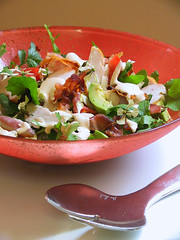
    Smoked chicken salad

    Here’s a life saver – a recipe of infinite variety and tastiness.


    Even over the last month, when time to spend on catering has been at a minimum, three different versions have emerged from the kitchen. The constants are a smoky flavoured bird (either chicken or quail, but duck would be great too), a mayonnaise-based dressing and Italian prosciutto or grilled pancetta. For ease butterflied and smoked quail or smoked chicken meat turn very nice tricks. If there’s time to cook, I’ll marinate chicken thighs in smoked paprika, olive oil, ground pepper and salt flakes and cook them in a single layer in a roasting pan for 25 minutes.

    Best’s Mayonnaise (the jar with the blue lid) is the best commercial preparation on the shelves. The smoky theme can continue into the dressing with the addition of smoked paprika as well as Dijon mustard and squeeze of lemon. At other times red pepper relish (available in jars) sparks up the humble bottled mayo.

    The choice of prosciutto (left in its natural state) or pancetta (grilled till crisp) will probably depend on ready availability. Either is delicious.

    Rocket usually gets a gig because it is the tastiest of all the green leaves with its nutty pepperiness. It has wintered over very well in the garden and now there are extra tasty and prettily veined flowers to sprinkle over the top. Sometimes waxy potatoes sneak into the salad, but only if I have time; ditto roasted and vinaigrette-dressed red pepper strips. A ripe avocado doesn’t go astray; neither do quarters of mini Roma tomatoes if there is no time to roast the peppers.

    Team up with 2007 Spring Vale Pinot Gris for a lively summer combination.

    The Recipe

    Smoked chicken salad (serves 2-3)
    1 large smoked chicken breast, cut into thin slices
    big handful rocket leaves, plus flowers if available
    8 mini Roma tomatoes, cut into quarters
    1 large avocado, cut into chunks
    8 thin slices pancetta
    Place a sheet of foil on a grill tray. Lay the slices of pancetta on top. Grill under high heat, turning once until the pancetta is golden on the edges. Cool on paper towel. As the pancetta cools it will crisp up. Break it up into pieces with your hands.
    Toss together the smoked chicken, rocket leaves, tomatoes, avocado and pancetta.
    Sprinkle the salad with the rocket flowers if available. Drizzle with the mayonnaise dressing and serve at once.
    For the mayonnaise dressing:
    half cup Best’s Mayonnaise
    1 tsp Dijon mustard
    one-quarter tsp Spanish smoked paprika
    generous squeeze lemon juice
    Mix all together and thin with a little hot water so that it is a fluid, dolloping consistency.

    Continue reading
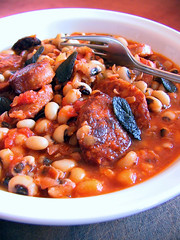
  • Black eyed beans & sausage

    Blackeyed beans & sausage

    Black eyed beans are great little folk of the pulse family. They have real character – an attractive earthy yet savoury flavour – and because they’re quite small they respond quickly to a short soak in lukewarm water followed by a relatively short cooking time.

    Buy the beans from a busy supplier who moves stock quickly. ‘Fresh’ rather than stale beans will cook far more quickly. Mine were done in barely 45 minutes after an hour’s soak which is pretty good compared with cannellini beans that can take much longer.

    Find a tasty cured sausage, Italian or otherwise, as this will be the robust flavour note in the dish. Spicy chorizo is good, the chilli lift complementing the beans and tomato most agreeably. Chilli is not uncommon in Italy, particularly in southern or eastern parts. The Abruzzi region (on Italy’s eastern coast) favours quite a bit of chilli in various dishes, as do the Romans and others further south who have come under Spanish and Moorish influences. Those plain eaters the Tuscans would approve of the rustic beans but be more inclined to use a much milder sausage. The choice is up to you.

    The slightly medicinal, bitter tang of sage combines nicely with the hearty beans, sausage and tomato. Here it is used in two guises – a sprig of fresh leaves cooked with the beans and extra leaves fried off until crispy as a last minute addition. Try with a juicy Italian red like Il Nero di Casanova />

    The Recipe

    Black eyed beans with sausage and tomato (serves 3-4)
    200g dried black eyed beans soaked in plenty of lukewarm water for at least half an hour
    large sprig sage leaves
    1 tbsp olive oil
    Drain the beans of their soaking water and then place in a large pot with the fresh sage, olive oil and enough water to cover well. Bring to a simmer and cook until tender – start checking at the 40 minute mark. Drain, reserving a cup of cooking liquid for later use. Discard the sage. You can store the beans in the fridge at this point if that is convenient.

    2 tbsp olive oil
    2-3 fat chorizo or other sausages, cut into thick oblique slices
    1 large onion
    2 cloves garlic
    400g tin Italian chopped tomatoes and their juice
    salt and pepper
    cooked black eyed beans (as above)
    reserved bean cooking liquid
    12 whole sage leaves, fried in olive oil until crispy and drained on paper towel

    Heat the olive oil in a large fry pan and fry the sausage slices for a few moments until lightly coloured. Remove. There will be some tasty scrapings in the pan so cook the onion and garlic gently in the remaining oil (without cleaning the pan) for about 8 minutes or until soft and translucent. Add the tomatoes and juice and season with salt and pepper. Cook for a minute or two. Add the beans and sausage and stir around well. Add about half a cup (to start with) of the bean cooking water and simmer for a minute for all the flavours to meld. Add more liquid if necessary. Lastly stir in the sage leaves. Serve immediately. This bean stew keeps well in the fridge.

    Continue reading